
Colitis (Acute and Chronic) Causes, Types, Symptoms, Diagnosis, Treatment
The Colon
The colon is the part of the large intestine, lying between the cecum and the rectum (Picture 1). It is the muscular tube, which starts in the lower right abdomen as the continuation of the small intestine, runs up as the ascending colon toward the liver, turns left and runs below the rib cage as the transverse (horizontal) colon toward the spleen, and turns down as the descending colon toward the pelvis, where it widens into the sigmoid colon that continues to the rectum. Its main function is to form a semi-solid stool from the undigested watery food remnants, and push it toward the sigma, where it is stored before being expelled out from the body.
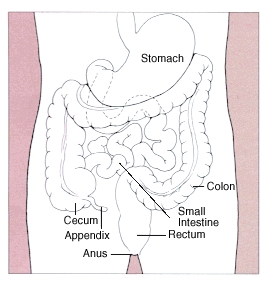
Picture 1. Colon – the part of the large intestine lying between the cecum and the rectum
(source: Wikimedia)
What Is Colitis?
Colitis refers to inflammation of the inner (mucosal) layer of the colon as a response to microbes or other harmful stimuli. It may be acute or chronic. The inflammation may beging from the small intestine (enterocolitis) and extend to the rectum (coloproctitis). During a colonoscopy, a swollen mucosa or ulcers may be seen and inflammatory cells can be found in a sample of mucosa under the microscope.
Causes of Colitis
Colitis may be caused by:
- Infection with bacteria, parasites or fungi (infectious colitis)
- Poisons from the food, or irritant substances in enema (chemical colitis)
- Autoimmune disorder (ulcerative and Crohn’s colitis)
- Impaired blood supply (ischemic colitis)
Causes of Acute Colitis
The causes of acute colitis include:
- Food poisoning with bacteria, where symptoms appear in 12-72 hours thereafter, or with parasites, where symptoms may appear weeks later. This is infectious colitis and may appear as traveler’s diarrhea. If blood appears in the stool, antibiotics are usually prescribed.
- Antibiotics that kill normal bowel bacteria thus enabling overgrowth of a harmful Clostridium difficile bacteria.
- Investigations like barium enema or colonoscopy may cause inflammation of the colon that is usually mild and resolves by itself in few days.
- Blood clot in abdominal artery, usually in persons after 50 with long term diabetes or heart disease, appears with sudden, severe abdominal pain and bloody mucus. Urgent medication to dissolve the blood clot is needed, otherwise a part of the colon may be permanently damaged and has to be removed by surgery.
- Infection of colonic diverticles, commonly in constipated persons is called diverticulitis that is treated with antibiotics.
- Blockage of the colon from severe constipation, or colon narrowing that is common in Crohn’s disease.
Causes of Chronic Colitis
Causes of chronic colitis include:
- Crohn’s colitis (Crohn’s disease), an autoimmune disorder, usually appearing in adolescents or young adults
- Ulcerative colitis, that is (beside Crohn’s disease) a type of inflammatory bowel disease (IBD)
- Ischemic colitis due to impaired blood supply to the colon, usually affecting persons after 50 with diabetes or atherosclerosis
- Microscopic (lymphocitic/collagenous) colitis
- Eosinophilic colitis
Signs and Symptoms
Sometimes, an affected person is not even aware of having colitis. Symptoms may appear suddenly or develop slowly during months, depending on the cause. However, in most cases, one or more of the following symptoms are present in all types of colitis:
- Abdominal pain ( left side abdominal pain or right side abdominal pain)
- Urgency, diarrhea (loose bowel movements), constipation, bloating
- Nausea
- Occasionally: fever, vomiting, blood in the stool, weight loss
- Tenderness upon pressing on the abdominal wall
- Stomach distension
- Occasionally: raised body temperature, skin rash, mouth ulcers, cracks (fissures) around the anus, small openings in the groin or in the stomach wall through which a fluid or liquid stool may leak.
Symptoms of Acute Colitis
- Sudden left or right side abdominal pain or cramps
- Urgency to have a bowel movement
- Diarrhea (loose bowel movements)
- Stomach swelling (bloating)
- Sometimes: bowel bleeding, fever, nausea, vomiting
Symptoms of Chronic Colitis
- Abdominal (stomach) pain or cramping
- Diarrhea (loose bowel movements) or constipation
- Nausea
- Sometimes: low grade fever, blood in the stool, skin rash, mouth ulcers
Types of Colitis
Known types of colitis include:
- Infectious colitis
- due to food poisoning with bacteria (salmonella, shigella, E.coli), or parasites (giardia, entameba)
- after antibiotic treatment: pseudomembranous colitis caused by Clostridium difficile
- after anal intercourse: infection by virus Herpes simplex
- in lowered immunity (AIDS, chronic disease): infection by yeast Candida albicans
- Crohn’s colitis (Crohn’s disease)
- Ulcerative colitis
- Ischemic colitis
- Microscopic (collagenous/lymphocitic) colitis
- Radiation colitis
- Mucous colitis
- Allergic colitis
- Eosinophilic colitis
The term indeterminate colitis is used, when inflammation is found in the colon but the cause or the type of the colitis can not be determined.
The term spastic colitis or spastic colon is used when no inflammation or other organic change can be found in the colon but the colon is irritated (and hence spasms) by food or stress. Nowadays, a term irritable bowel syndrome (IBS) is used for this condition.
Diagnosis of Colitis
The type of colitis may be sometimes hard to determine and often a combination of positive results from several tests are required to make a diagnosis:
- Personal history
- Short term (hours to weeks) symptoms like left or right side stomach pain, diarrhea, blood in the stool, and fever are suspicious for infectious colitis due to
- food poisoning
- antibiotic therapy (pseudomembranous colitis caused by Clostridium difficile)
- Long term (months to years) symptoms
- in an adolescent or adult: Crohns’ disease, ulcerative colitis
- after 50: ischemic colitis
- Short term (hours to weeks) symptoms like left or right side stomach pain, diarrhea, blood in the stool, and fever are suspicious for infectious colitis due to
- Blood tests: Leukocytes may be elevated in infectious colitis and inflammatory bowel disease (Crohn’s disease, ulcerative colitis)
- Stool tests: Hemoccult may reveal blood in the stool in any type of colitis. Negative test does not exclude colitis!
- X-ray with barium enema may show big ulcers, like in ulcerative colitis, or narrowings (in Crohn’s disease)
- CT may show thickened colonic wall and eventual abscesses in and around the colonic wall
- Colonoscopy may show swollen mucosa with ulcers but sometimes no changes can be seen
- Biopsy means cutting off a small piece of colonic mucosa for histologic investigation (checking the tissue under the microscope). Often only at this stage a diagnosis of colitis and its exact type can be made.
Treatment of Acute and Chronic Colitis
Treatment of colitis depends on the underlying cause. It may include:
- Dietary modification.
- Antibiotics for bacterial infections.
- Surgery in the event of colon obstruction or perforation.

